
Last Updated: November 21, 2026
Quick Summary
Feeling anxious for no reason usually means your body’s alarm system has fired without an obvious threat, and there is almost always a hidden trigger you can’t name yet. Common causes include stress, poor sleep, skipped meals, caffeine, hormonal changes, and past trauma. Naming the feeling and lengthening your exhale can help settle it.
- Nearly half of people polled in 2026 felt more anxious than the year before, up from 43% the year prior.
- Your nervous system responds to perceived threat, so subtle cues, skipped meals, or poor sleep can trip the alarm.
- Name the feeling, exhale longer than you inhale, and press your feet into the floor to interrupt the alarm.
- The 3-3-3 rule means naming three things you see, three sounds you hear, and moving three body parts.
- Anxiety often spikes at night because distractions are gone and your brain starts scanning for threats.
Table of Contents
- Why Do I Feel Anxious for No Reason?
- Common Causes of Unexplained Anxiety
- That Uneasy Feeling in Your Body for No Reason
- How to Stop Feeling Anxious for No Reason
- What Is the 3-3-3 Rule for Anxiety?
- Why Do I Feel Anxious for No Reason at Night?
- When Unexplained Anxiety Needs Professional Support
- Building Long-Term Emotional Resilience
- Frequently Asked Questions
Why Do I Feel Anxious for No Reason?
Nearly half of people polled in 2026 said they felt more anxious than the year before, up from 43% the year prior, according to the American Psychiatric Association’s 2026 Annual Mental Health Poll.
Unexplained anxiety is real anxiety. It just hasn’t shown you its source.
Below, we’ll walk through the hidden triggers, the physical signals, and a simple step-by-step plan for the moments when your body feels on edge and your mind can’t explain why.
The Anxiety You Can’t Explain Is Still Real
Anxiety is your body’s alarm system firing without a clear emergency. That’s the whole thing in one sentence.
The alarm is real. The danger may not be.
Think about the last time your heart raced before a meeting or a hard conversation. Your body reacted before your brain caught up.
What most guides miss is this: your nervous system responds to perceived threat, not proven threat. A subtle cue, a skipped meal, or a rough night of sleep can trip the alarm.
Common Causes of Unexplained Anxiety
The cause is often a stack of small things, not one big thing. of adults in any given year, according to the National Institute of Mental Health, and everyday factors can spike symptoms even without a diagnosis.
Here are some common contributors:
- Stress and chronic mental overload from work or caregiving
- Sleep deprivation and poor sleep quality
- Skipped meals and low blood sugar
- Caffeine and other stimulants
- Hormonal changes
- Trauma and past experiences
- Genetics and inherited traits
- Medical conditions or medication side effects
Stress and Chronic Mental Overload
Chronic stress keeps your stress hormones like cortisol and adrenaline elevated. Your body stays in a low-grade fight-or-flight response long after the stressful event ends.
The result? A constant hum of restlessness and overthinking you can’t tie to anything specific.
Sleep Deprivation and Poor Sleep
One bad night can make you feel anxious the next day. Poor sleep raises your stress response and makes your amygdala, the brain’s threat detector, more reactive.
The fix isn’t dramatic. A consistent sleep and wake time does more than most people expect.
Hormonal Changes and Other Biological Factors
Hormones shift your brain chemistry in ways that affect mood and anxiety. This is why anxiety can show up during life transitions, monthly cycles, or periods of major change.
For a closer look at how anxiety shows up biologically, read our guide on anxiety symptoms in women.
That Uneasy Feeling in Your Body for No Reason
That uneasy feeling in your body for no reason is your nervous system talking. It shows up as physical anxiety symptoms before you ever name the emotion.
Watch for these signals:
- Racing heart or a skipped heartbeat
- Shortness of breath
- Muscle tension, especially in the jaw and shoulders
A panic attack is a sudden surge of these symptoms, often peaking within minutes. It feels frightening but is not dangerous on its own.
How to Stop Feeling Anxious for No Reason
Working with your body first, then your thoughts, is a practical way to ease anxiety. Here is a step-by-step response you can try.
Minute one: interrupt the alarm.
- Name it. Say quietly, “This is anxiety.” Naming an emotion reduces its intensity because it shifts activity from the brain’s alarm center toward the thinking regions. Keep the label neutral, not judgmental.
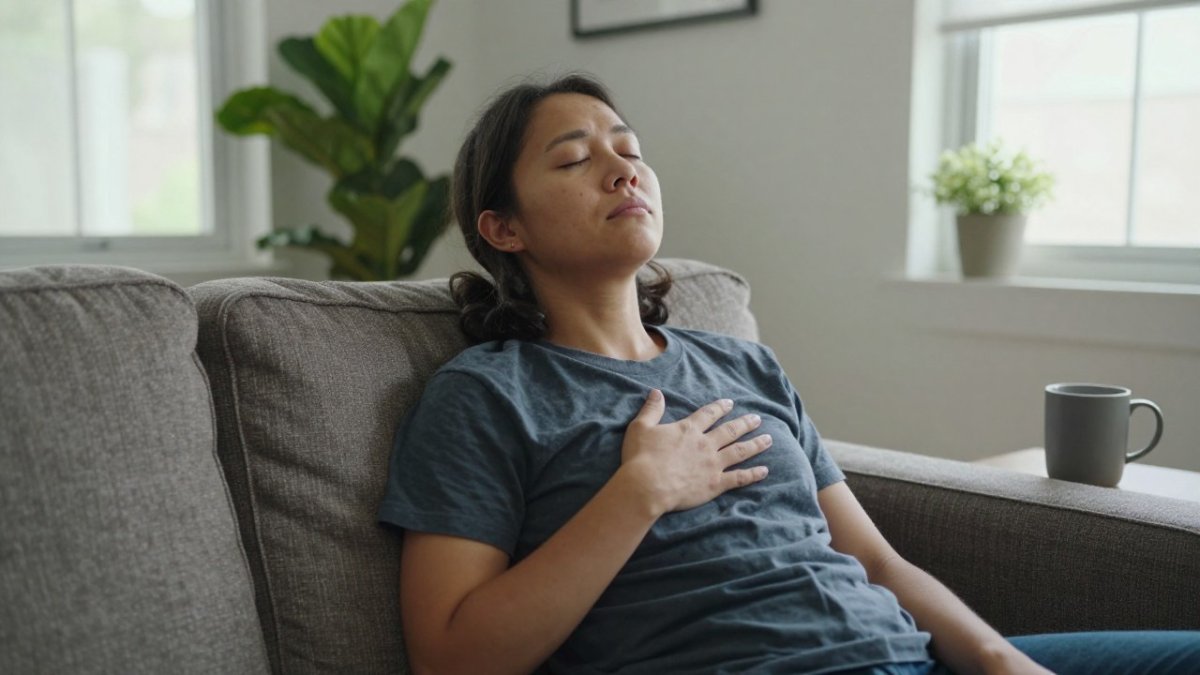
- Lengthen your exhale. Inhale through your nose for four counts, exhale for six. Repeat five times. Many people find a long exhale helps them feel calmer. If counting is hard, hum on the exhale instead.
- Anchor to something physical. Press both feet into the floor and notice the contact for ten seconds. This gives your brain concrete sensory input to process instead of scanning for threats.
Minutes two to five: settle the body.
- Ground your senses. Use the 5-4-3-2-1 method below if your thoughts are still racing.
- Move gently. A short walk, stretching, or shaking out your hands releases built-up tension. Movement burns off the adrenaline your body already released.
- Check the basics. Drink a glass of water. Eat something if you skipped a meal or it’s been more than four hours since you ate. Low blood sugar mimics anxiety almost exactly.
After the wave passes: learn from it.
- Write it down. Note what was happening in the hour before the feeling hit: sleep, food, caffeine, conflict, screens, deadlines. Patterns rarely show up in the moment but almost always show up on paper.
- Decide what comes next. Ask one question: did this pass on its own, or is this part of a larger pattern? A single episode that settles is a signal to rest and check your basics. Repeated episodes across weeks are a signal to track more carefully and consider support.
Watch out: if a step makes you feel worse, stop and move to the next one. For a deeper set of tools, our full guide on coping strategies for anxiety walks through each step in detail.
Grounding Techniques You Can Use Anywhere
Grounding techniques pull your attention out of the spiral and into the present moment. They work in meetings, on trains, in bed at 2 a.m.
Try these:
- 5-4-3-2-1 method: Name 5 things you see, 4 you feel, 3 you hear, 2 you smell, 1 you taste.
- Cold water: Run cool water over your wrists for 30 seconds.
- Object focus: Pick one nearby object and describe it in detail. (Source: how anxiety shows up biologically)
If overwhelm is the main issue, our mindfulness exercises for emotional overwhelm offer more options.
Here is the step-by-step response the article suggests, with the timing for each stage.
| Stage | What to do | When |
|---|---|---|
| Name it | Say quietly, “This is anxiety” | Minute one |
| Lengthen your exhale | Inhale for four counts, exhale for six, repeat five times | Minute one |
| Anchor to something physical | Press both feet into the floor for ten seconds | Minute one |
| Ground your senses | Use the 5-4-3-2-1 method | Minutes two to five |
| Move gently | Short walk, stretching, or shaking out your hands | Minutes two to five |
| Check the basics | Drink water; eat if it’s been more than four hours | Minutes two to five |
| Write it down | Note the hour before: sleep, food, caffeine, conflict, screens | After the wave passes |
| Decide what comes next | Ask if it passed on its own or is a larger pattern | After the wave passes |
What Is the 3-3-3 Rule for Anxiety?
The 3-3-3 rule for anxiety is a quick grounding method: name three things you can see, three sounds you can hear, and move three parts of your body. It takes under a minute and works almost anywhere.
Why it works: it interrupts the overthinking loop and gives your brain concrete input to process.
Use it when:
- Your thoughts start racing
- You feel a wave of free-floating anxiety
- You need to reset before a meeting or conversation
It isn’t a cure. It’s a pause button, and a pause is often all you need to break the spiral.
Why Do I Feel Anxious for No Reason at Night?
Anxiety often spikes at night because the distractions are gone. With no tasks to occupy your mind, your brain turns inward and starts scanning for threats.
Add poor sleep, low blood sugar from a late dinner, and quiet darkness, and the stage is set.
What helps:
- Keep a consistent wind-down routine
- Dim screens an hour before bed
- Write down worries so your brain can “set them down”
If nighttime anxiety is frequent, it’s worth tracking patterns for a week or two.
When Unexplained Anxiety Needs Professional Support
Sometimes anxiety needs more than self-care. That’s not a failure. It’s information.
Reach out for professional help if you notice:
- Anxiety most days for weeks
- Trouble sleeping, eating, or working
- Panic attacks that keep recurring
A mental health assessment can clarify what’s happening and what would help. You can learn more about individual therapy and what that support looks like.
Watch out: if you ever have chest pain, fainting, or trouble breathing that feels new and severe, get medical care right away. Anxiety and some medical conditions share symptoms, and a doctor should rule out the physical causes.
Building Long-Term Emotional Resilience
Emotional resilience is built in small, repeated habits, not one big overhaul. The goal is a nervous system that recovers faster from stress. A simple tracker below can help you see which habits matter for you.
Focus on these wellness habits:
- Sleep: same bedtime, most nights
- Movement: even a 15-minute walk counts
- Food: regular meals to steady blood sugar
A Simple Symptom-and-Trigger Tracker
A tracker turns vague unease into visible patterns. You do not need an app; a notebook or a note on your phone works. Each day, log six fields in under a minute:
- Time of day the anxiety showed up
- Sleep the night before (hours and quality, 1-5)
- Food and caffeine since waking (meals skipped? last cup?)
- Physical symptoms (racing heart, tension, stomach upset)
- Context (what was happening in the hour before)
- Intensity (1-10)
After two weeks, read it back and look for three things: the same time of day, the same physical symptom, and the same context. Most people find at least one repeating thread, often something they never noticed in the moment, like a skipped lunch or a late coffee. That thread is your first place to experiment.
Watch out: a tracker is for spotting patterns, not for diagnosing yourself. If the log shows anxiety most days for weeks, that is useful information to bring to a clinician, not a reason to self-treat.
For long-term regulation skills, our guide on DBT skills for emotional regulation is a good next step.
Frequently Asked Questions
Why do I suddenly get anxious for no reason?
Sudden anxiety without an obvious trigger often comes from subtle factors your brain registers before you do. Poor sleep, skipped meals, caffeine, hormonal shifts, or accumulated stress can activate your body’s fight-or-flight response even when nothing visibly threatening is happening. Anxiety disorders generally involve a mix of life experiences and inherited traits, and their causes are not fully understood. The feeling is real even when the reason is not immediately clear, and tracking your symptoms can help you spot patterns over time.
Can anxiety happen without an obvious trigger?
Yes. Anxiety does not always need a visible cause. Many people experience rising anxiety without a single identifiable event. Internal cues like muscle tension, shallow breathing, or an unsettled stomach can signal perceived threat even when your conscious mind cannot name one. This is sometimes called free-floating anxiety, and it is a recognized pattern worth discussing with a mental health professional.
What is the 3-3-3 rule for anxiety and does it work?
The 3-3-3 rule is a grounding technique that asks you to name three things you can see, three sounds you can hear, and three parts of your body you can move. It works by pulling your attention away from anxious thoughts and back into the present moment through your senses. Grounding techniques like this are commonly used in CBT and DBT to interrupt the fight-or-flight response. It is not a cure for anxiety disorders, but it can be a useful tool during moments of unexplained anxiety while you work on longer-term coping strategies.
Why do I feel anxious for no reason at night?
Nighttime anxiety often happens because the distractions of the day fade away, leaving quiet space for worries and physical sensations to surface. Poor sleep and anxiety feed each other: sleep deprivation can intensify anxiety. Caffeine consumed late in the day, blood sugar drops from skipped meals, and hormonal changes can also contribute. A calming bedtime routine and consistent sleep schedule can help reduce nighttime anxiety over time.