

Last Updated: November 17, 2026
Quick Summary
Supporting a loved one through trauma recovery means offering steady, consistent presence rather than perfect words. Educate yourself about trauma symptoms, ask what helps before a crisis, and respect their choices and independence. Protect your own wellbeing too, since sustainable support depends on pacing yourself and setting limits you can keep.
- Simple phrases like I believe you and I’m not going anywhere open the door to conversation.
- Avoid minimizing phrases such as everything happens for a reason or at least it wasn’t worse.
- Ask on a calm day what helps during a flashback, and write the answers down.
- During a flashback, say their name, orient them to place and time, and offer grounding steps.
- Specific offers like bringing dinner Thursday at six beat vague offers of help.
Table of Contents
- Why Your Steady Presence Matters in Trauma Recovery
- What to Say to a Traumatized Person (and What to Avoid)
- How to Comfort a Traumatized Person Without Pressure
- How to Help Someone with Trauma Flashbacks
- Calming Techniques for PTSD That Supporters Can Learn
- Practical Help, Routine, and Respecting Independence
- Protecting Your Own Wellbeing While You Support Someone
- Building a Support Plan That Grows With Their Recovery
- Frequently Asked Questions
Why Your Steady Presence Matters in Trauma Recovery
Trauma recovery is the gradual process of rebuilding safety, trust, and connection after a traumatic event. Supporting a loved one through trauma recovery rarely looks dramatic.
That steadiness matters more than perfect words. Research from the National Library of Medicine’s 2024 review on social support and trauma recovery found that educating family and friends about PTSD symptoms can strengthen their support skills.
Below, we’ll show you exactly what to say, what to avoid, and how to hold steady when things get hard.
What to Say to a Traumatized Person (and What to Avoid)
The best thing to say is usually simple: “I’m here, and I’m not going anywhere.” People healing from trauma often need permission to talk, not pressure to talk.
Words That Open the Door
- “I believe you.”
- “You don’t have to explain anything right now.”
- “What would feel helpful today?”
- “I’m not going anywhere.”
Phrases That Can Cause Harm
- “Everything happens for a reason.”
- “At least it wasn’t worse.”
- “You should try to move on.”
- “Why didn’t you just leave?”
These phrases minimize pain or assign blame. Both can push someone back into shame. Skip them, even when you mean well.
How to Comfort a Traumatized Person Without Pressure
Comfort starts with your body, not your words. Sit at the same level. Keep your voice low and slow. Ask before you touch.
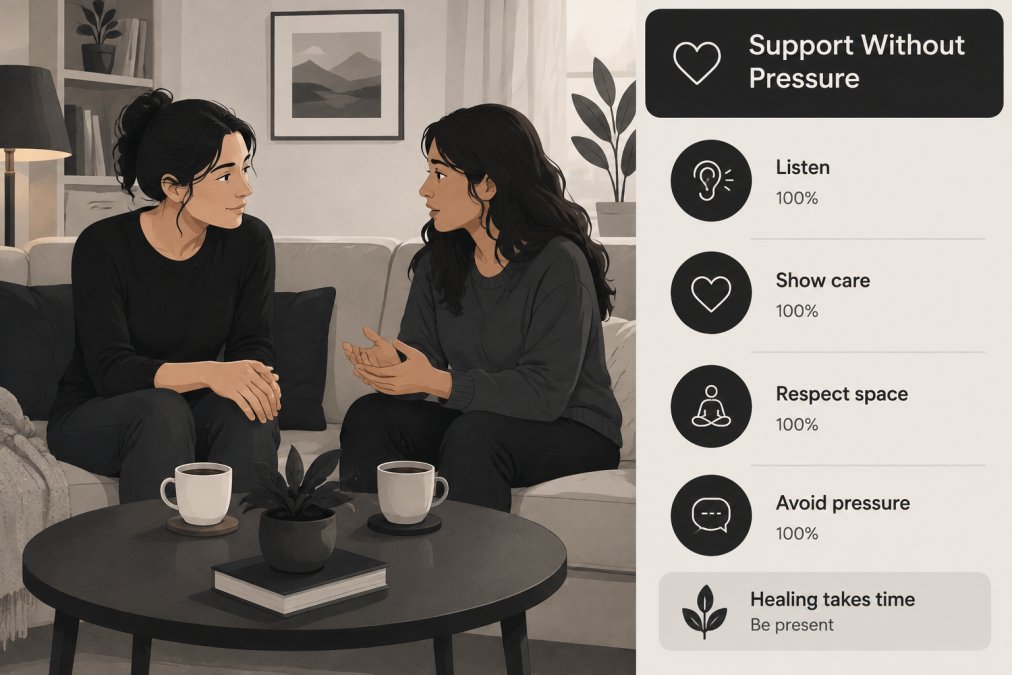
Offer choices instead of instructions. “Would you like company, or some quiet time?” respects independence. So does silence. Sitting together without talking can feel safer than a conversation.
What most guides miss is this: comfort is not about fixing the feeling. It’s about making the feeling less lonely.
How to Help Someone with Trauma Flashbacks
During a flashback, the person’s brain is reliving the event, not remembering it. The amygdala and the body’s alarm system fire as if the danger is happening now, while the prefrontal cortex, the part that tracks time and context, goes quiet. That is why arguing with what they feel does not work. Your job is not to correct them. Your job is to help their body find the present.
What a Flashback Looks Like
Signs include a blank stare, rapid breathing, shaking, sudden panic, sweating, or seeming “far away.” The person may not respond to their name at first, may not recognize you, or may flinch at a touch. Some people go silent and still instead of visibly panicking. For practical day-to-day strategies between episodes, our article on coping with trauma triggers in daily life walks through what helps.
Ask Before the Crisis, Not During It
The single most useful thing you can do is have a calm conversation on a good day: “If you ever get pulled back into it, what helps? What should I not do?” Write the answers down. People often know what works, a certain song, a cold glass of water, a specific person’s voice, the dog. During the episode, they may not be able to tell you, so the plan you made together does the talking.
Grounding Steps You Can Offer
- Say their name, slowly and calmly, and identify yourself: “It’s Sam. I’m right here.”
- Remind them where they are and when: “You’re in your living room. It’s Tuesday evening. You’re safe right now.”
- Offer a physical anchor: “Can you press your feet into the floor? Can you feel the chair?”
- Ask them to name five things they can see, four they can hear, three they can touch.
- Keep your voice low and slow, and stay until their breathing settles. Don’t rush them or ask a lot of questions.
Watch out: don’t grab, shake, or crowd someone mid-flashback. Unexpected touch can feel like a threat and make the episode worse. Ask first, “Can I put a hand on your arm?”, and accept a no.
Flashback or Panic Attack?
They can look alike, and the response overlaps: stay calm, lower the stimulation, breathe slowly together, and stay present. A panic attack usually peaks within about ten minutes and then eases. A flashback tends to last as long as the person is pulled into the memory and can stop abruptly once they reconnect to the present. You do not need to diagnose which one it is. You need to be steady and help them land here.
When to Seek Urgent Help
Call 911 or take the person to an emergency room if they are in danger of hurting themselves or someone else, if they have taken an overdose or been injured, if they are disoriented and cannot be reoriented, or if the episode does not settle and they seem to be getting worse. The 988 Suicide & Crisis Lifeline is available by call or text, 24 hours a day, for moments when you are scared and need guidance in real time.
After the Episode
When the person comes back, keep it simple. “You’re okay. I’m here. You don’t have to talk about it.” Offer water, a blanket, quiet. Don’t debrief the event unless they want to. Later, when things are calm, you can gently ask what helped and update your plan together.
Calming Techniques for PTSD That Supporters Can Learn
Calming techniques for PTSD work best when you practice them before you need them. A slow exhale, longer than the inhale, signals safety to the nervous system. Try it together during a calm moment, not a crisis.
Other options include:
- A five-minute walk outside
- Naming five things you can see and four you can hear
- Holding something cold, like a glass of water
SAMHSA notes that trauma-informed approaches emphasize safety, trust, and collaboration. That starts with consent. Our guide to mindfulness exercises for emotional overwhelm has step-by-step options you can use in the moment.
Practical Help, Routine, and Respecting Independence
Specific help beats vague offers. “Let me know if you need anything” puts the work on them. “I’m bringing dinner Thursday at six” doesn’t.
Support daily routine where you can. Sleep, meals, and movement steady the nervous system. Offer a walk, not a lecture. Cook together. Keep it low-key.
Respect boundaries, too. If they say no, accept it the first time.
Protecting Your Own Wellbeing While You Support Someone
You cannot pour from an empty cup, and supporter burnout is real. People who care for someone through trauma often carry what is called secondary stress, the toll of hearing about, witnessing, and absorbing another person’s pain. It builds slowly, which is why it is easy to miss until you are already running on empty.
Signs to Watch For in Yourself
- Dreading check-ins or feeling relief when plans cancel
- Feeling resentful, numb, or irritable with the person you are helping
- Losing sleep, or sleeping far more than usual
- Skipping your own meals, movement, or time with friends
- Replaying their story in your head, or feeling jumpy and on edge
- Drinking more, or reaching for other numbing habits
None of these make you a bad supporter. They are signals that your own nervous system needs attention.
Set Limits You Can Actually Keep
A limit is not a rejection. “I can talk for twenty minutes tonight, and then I need to sleep” is kinder than an hour you will resent. Decide in advance what you can offer, time, rides, meals, a listening ear on certain days, and say it plainly. If you say yes when you mean no, the no comes out later as distance or irritation, which hurts more.
Build a Steady Self-Care Routine
Small, repeatable habits protect you better than occasional big gestures:
- Move your body most days, even a short walk
- Keep a sleep schedule and protect it
- Eat regular meals, not just coffee and leftovers
- Keep at least one relationship that is not about the trauma
- Take a real break, a few hours where you are not on call
- Notice your own breath: a slow exhale longer than the inhale calms your nervous system too
Get Your Own Support
You are allowed to need support while giving it. If you are struggling, our piece on practicing self-compassion during trauma healing is a good place to start.
Watch out: if you find yourself feeling hopeless, unable to function, or thinking about hurting yourself, that is not something to push through alone. The 988 Suicide & Crisis Lifeline is available by call or text, 24 hours a day.
Remember the Long View
Supporting someone through trauma is a marathon, not a sprint. The supporters who last are not the ones who give the most, they are the ones who pace themselves, keep their own life intact, and let others share the load. Your wellbeing is not separate from their recovery. It is part of what makes your support sustainable.
Building a Support Plan That Grows With Their Recovery
A support plan is a simple written agreement about how you’ll show up. Keep it flexible, because recovery changes shape over time.
| Element | What to Agree On | Review |
|---|---|---|
| Check-ins | How often, and by text or call | Monthly |
| Triggers | What to avoid, what helps | As needed |
| Boundaries | What you can and can’t do | Monthly |
| Backup | Who else they can reach | Every 3 months |
| Professional care | Whether they want help finding it | As needed |
Recovery is rarely a straight line. A 2016 narrative case study in PubMed Central described a client with multiple traumas and severe symptoms moving through an ongoing recovery process, which reflects what many families see: progress with hard days mixed in. If you want a realistic sense of pacing, read how long trauma recovery takes. And if your loved one wants more support, individual therapy can be part of the plan.
Supporting someone through trauma recovery is a long game, and you don’t have to play it perfectly. You need steadiness, honest boundaries, and a plan that can bend without breaking. That’s where Zen Horizons comes in. Our clinicians specialize in trauma and addiction, using evidence-based approaches like CBT, EMDR, and DBT in a judgment-free environment.
Frequently Asked Questions
How can I support a loved one without pressuring them to talk?
Let them set the pace. Say something like, “I’m here whenever you want to talk, and it’s okay if you don’t.” Then follow through by staying available without asking repeatedly. Research on social support and trauma recovery notes that educating yourself about post-traumatic stress can strengthen your support skills. Keep invitations open, respect silence, and let small conversations happen naturally rather than scheduling a big disclosure.
What should I say to someone who has experienced trauma?
Lead with validation rather than advice. Phrases like “I believe you” and “That sounds incredibly hard” signal safety and nonjudgment. Avoid blame, minimizing, or pushing for details. If you are unsure what to say, honesty works: “I don’t have the right words, but I care about you.” The goal is empathy, not a perfect script, and your steady presence often matters more than any single sentence.
How do I help someone during a trauma flashback?
Stay calm and keep your voice low and steady. Remind them gently where they are and that they are safe now. Offer simple grounding options, such as feeling their feet on the floor, naming objects in the room, or holding something cold. Ask before touching them. Give them time, avoid crowding, and stay afterward to help them settle. Flashbacks are intense but temporary, and your calm presence helps the nervous system come back to the present.
What are some calming techniques for PTSD I can suggest?
Try slow breathing with a longer exhale, a body scan from head to toe, or the 5-4-3-2-1 senses exercise. Gentle movement, time outdoors, and a consistent sleep routine also help regulate stress over time. Offer these as options rather than instructions, and let your loved one choose what feels comfortable. Practicing one technique together during a calm moment can make it easier to use during a stressful one.