

Last Updated: November 5, 2026
Quick Summary
Anxiety symptoms in women are the physical, emotional, and mental signs that appear when your body’s alarm system stays switched on, ranging from racing thoughts and persistent worry to a pounding heart, muscle tension, and trouble sleeping. Nearly one in three women will deal with an anxiety disorder at some point, and women are diagnosed at nearly twice the rate of men.
- Women are diagnosed with anxiety disorders at 23.4% compared to 14.3% in men.
- 40.4% of young women ages 18 to 25 are affected by anxiety.
- Night anxiety often shows up as lying awake with racing thoughts and a racing heartbeat.
- Perimenopause anxiety often arrives in waves tied to hormonal swings.
- Use four dimensions to judge symptoms: persistence, distress, avoidance, and interference.
Table of Contents
- Common Anxiety Symptoms in Women
- Weird Physical Symptoms of Anxiety That Catch Women Off Guard
- Why Anxiety Symptoms Are More Common in Women
- Anxiety Symptoms in Women at Night
- Anxiety Symptoms in Women Menopause Changes
- Ways to Reduce Anxiety That You Can Start Today
- When Anxiety Symptoms Deserve Professional Support
- Building Your Personal Anxiety Support Plan at Zen Horizons
- Frequently Asked Questions
Common Anxiety Symptoms in Women
Anxiety symptoms in women are the physical, emotional, and mental signs that show up when your body’s alarm system stays switched on. Nearly one in three women will deal with an anxiety disorder at some point, according to NIH research on lifetime anxiety prevalence. Many people describe the same experience: they thought they were just “stressed” until someone named what was actually happening.
Anxiety is your body’s response to perceived threat, and it becomes a problem when that response fires without a real danger present. The signs range from racing thoughts to stomach trouble, and they often look different in women than in men. Below, we break down the emotional and physical signals, why they hit women harder, and what you can do starting today.
Emotional and Cognitive Signs
The mental side of anxiety is loud. You might notice:
- Persistent worry that won’t switch off, even about small things
- Racing thoughts that jump from one problem to the next
- Feeling nervous, irritable, or on edge most days
- Difficulty concentrating or trouble making decisions
- A vague sense of impending danger or dread
- Avoidance of situations that used to feel normal
These cognitive signs often drive the behavior changes people notice first. You start skipping plans, double-checking everything, or snapping at people you love. If racing thoughts and emotional swings are part of your pattern, our guide to DBT skills for emotional regulation walks through concrete techniques for settling them.
Physical Symptoms You Might Not Expect
Your body keeps the score. Common physical signs include:
- Increased heart rate or a pounding chest
- Breathing rapidly or shortness of breath
- Sweating and cold or tingling hands and feet
- Muscle tension, especially in the neck and jaw
- Fatigue that sleep doesn’t fix
- Trouble sleeping or insomnia
- Nausea and gastrointestinal symptoms
Anxiety isn’t “all in your head.” It’s a full-body event, and the physical symptoms are often what send women looking for answers.
Weird Physical Symptoms of Anxiety That Catch Women Off Guard
Some anxiety symptoms don’t look like anxiety at all. Women tell us they were sure something else was wrong before they connected the dots.
Here are the odd ones:
- A choking feeling or a lump in your throat
- Tingling in the face or scalp
- Dizziness when you stand up
- Bloating and digestive upset with no food trigger
- Jaw clenching that leaves you with headaches
- A sudden urge to escape a room for no clear reason
These weird physical symptoms of anxiety are real, and they’re common. The tricky part is that they mimic other conditions. That’s why tracking matters. Write down when each symptom shows up, how long it lasts, and what was happening right before. Patterns reveal more than any single bad day.
Watch out: assuming a symptom is “just anxiety” without a check-up can make you miss something treatable. A doctor can rule out medical causes while you work on the anxiety side.
Why Anxiety Symptoms Are More Common in Women
The numbers are hard to argue with. Women are diagnosed with anxiety disorders at nearly twice the rate of men, at 23.4% compared to 14.3%, according to Huntington Psychology’s state-by-state anxiety breakdown. And 40.4% of young women ages 18 to 25 are affected, per Compass Health Center’s young adult report.
Why the gap? A few forces stack up:
- Hormonal changes that shift mood and stress response
- Higher rates of certain disorders, including generalized anxiety, panic disorder, and specific phobias, as NIH research confirms
- Social pressure and caregiving load
- Stress from work, family, and life transitions
The result is a heavier symptom burden, and it often starts young. The CDC reports that 13% of girls ages 3 to 17 have a current, diagnosed anxiety disorder (CDC children’s mental health data).
Anxiety Symptoms in Women at Night
Night is when anxiety gets louder. With no distractions, persistent worry moves in, and your body ramps up right when you need to wind down.
Anxiety symptoms in women at night often look like this:
- Lying awake with racing thoughts
- A racing heartbeat as soon as you close your eyes
- Muscle tension that keeps you rigid
- Waking at 3 a.m. with dread
- Needing to check things repeatedly before bed
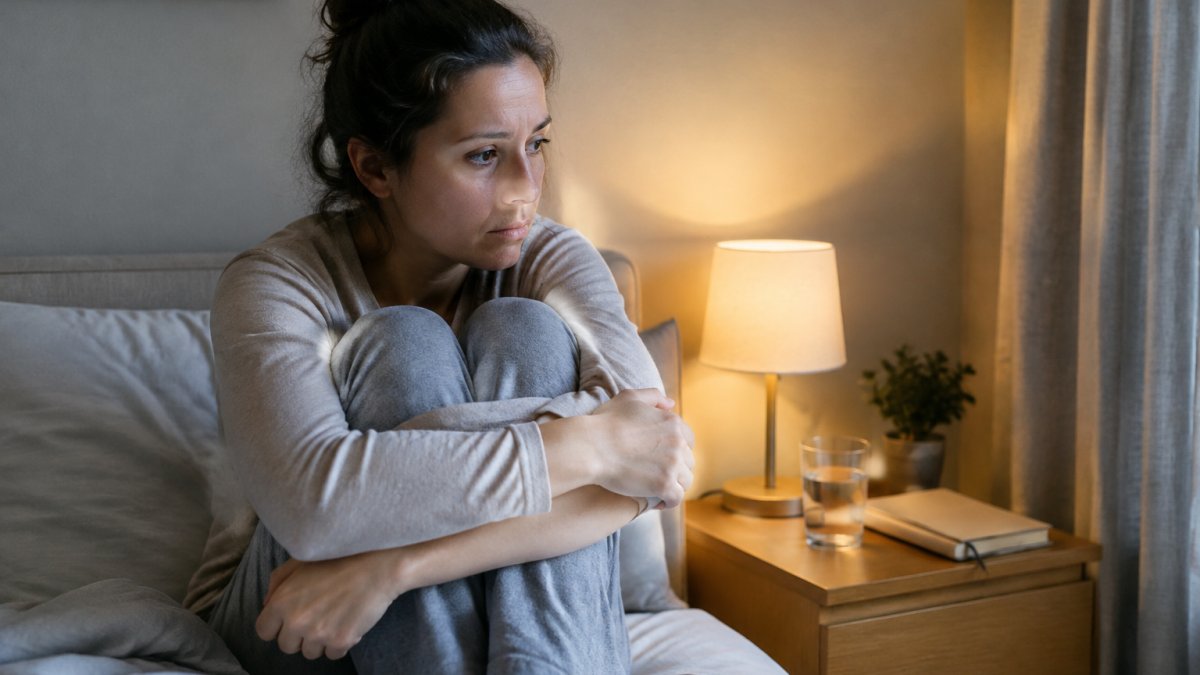
The fix isn’t “just relax.” Try a wind-down routine: dim lights an hour before bed, park worries in a journal, and use slow breathing. If insomnia keeps repeating, that’s a signal worth acting on.
Anxiety Symptoms in Women Menopause Changes
Menopause reshapes the anxiety picture, but the shift usually starts earlier than people expect. Most women move through perimenopause first, a transition that can last several years, and that is often when anxiety symptoms first intensify.
What tends to shift across the transition:
- Hot flashes and night sweats that arrive with a surge of heart-pounding that feels indistinguishable from panic
- Sleep disruption from night sweats and early waking, which lowers the threshold for worry the next day
- Heart palpitations that are hormonal in origin but read to the brain as danger
- Irritability and mood swings that come and go with no clear trigger
- Brain fog and word-finding trouble that adds a layer of “something is wrong with me” worry
- New or worsening health anxiety as checkups, screenings, and body changes pile up
A key distinction worth knowing: perimenopause anxiety often arrives in waves tied to hormonal swings, while post-menopause anxiety tends to be steadier and more tied to sleep loss, life transitions, and health concerns.
Tracking helps here more than at any other stage. Note the date, the symptom, how long it lasted, how you slept the night before, and whether a hot flash or night sweat came first.
Watch out: assuming every new symptom in this stage is hormonal can delay evaluation of thyroid changes, heart rhythm issues, or sleep disorders that produce overlapping signs.
If symptoms spike during this stage, keep tracking them alongside your cycle or stage.
Ways to Reduce Anxiety That You Can Start Today
Small, repeatable actions beat big overhauls. Here are ways to reduce anxiety you can begin right now:
- Breathe slowly for two minutes: in for four, out for six
- Move your body daily, even a short walk
- Limit caffeine and check how it affects you
- Name the worry out loud or in writing
- Set one boundary this week
- Use the 5-4-3-2-1 grounding method when panic rises
- Protect sleep with a consistent bedtime
Pick one. Do it for a week. Then add another. Our step-by-step guide to effective coping strategies for anxiety gives you a full menu to work from.
When Anxiety Symptoms Deserve Professional Support
Most guidance on this topic stays vague, “talk to someone if it bothers you.” A clearer threshold helps more. Use four dimensions to judge whether symptoms have crossed from manageable to worth acting on: persistence, distress, avoidance, and interference.
- Persistence: symptoms most days for two weeks or more, or repeated episodes that keep returning after brief calm stretches
- Distress: the symptoms themselves are distressing, you dread them, you feel ashamed of them, or they dominate your attention
- Avoidance: you are skipping work, school, social plans, appointments, or errands to prevent symptoms
- Interference: sleep, appetite, concentration, relationships, or job performance are measurably worse than they were a few months ago
Any one of these on its own is worth a conversation. Two or more together is a stronger signal. You do not need to be in crisis, and you do not need a formal label, to take the next step.
A few specific patterns that point toward getting support sooner rather than later:
- Panic attacks that interrupt your day or send you to urgent care
- Relying on alcohol, cannabis, or other substances to take the edge off
- Sleep or appetite changes that have lasted more than a few weeks
- Physical symptoms, palpitations, breathlessness, gastrointestinal changes, that have not been evaluated
- Thoughts of self-harm, or feeling that life is not worth living (seek help immediately)
| Symptom Pattern | What It Suggests | Next Step |
|---|---|---|
| Occasional worry, short-lived | Normal stress response | Self-care and tracking |
| Symptoms most days, mild, no interference | Rising anxiety | Coping skills and monitoring |
| Avoidance, sleep loss, or interference at work or home | Anxiety affecting daily life | Reach out for support |
| Panic, substance use to cope, or self-harm thoughts | Significant distress | Prompt professional care |
A practical next step is to build a short record before you reach out: what the symptom was, when it happened, how long it lasted, what was happening right before, how you slept, and what you had to skip because of it.
Watch out: waiting for symptoms to become severe before acting is common and rarely helps. Our guide to therapy for high-functioning anxiety explains how support helps even when nothing looks wrong from the outside. Research backs the approach: a Washburn University case study found clinically meaningful improvement in anxiety symptoms using a structured treatment protocol.
Building Your Personal Anxiety Support Plan at Zen Horizons
A support plan turns insight into action. At Zen Horizons, we build that plan around you, not a template.
Our clinicians bring over a decade of expertise in trauma and addiction, using evidence-based approaches including CBT, EMDR, and DBT. You get a judgment-free space and a plan that fits your life. A Rowan University study showed structured cognitive-behavioral therapy reduced anxiety symptoms, which is the kind of grounded work we do. You can learn more about individual therapy and what those sessions involve.
When you’re ready, book online and take the first step.
Frequently Asked Questions
What are the most common anxiety symptoms in women?
The most common anxiety symptoms in women include persistent worry, feeling nervous, irritable, or on edge, racing thoughts, and trouble concentrating. Physical signs like a rapid heartbeat, shortness of breath, sweating, muscle tension, fatigue, and insomnia are also frequent. Anxiety disorders are diagnosed more often in women than in men, so these symptoms are both common and worth taking seriously. Tracking when they appear and how long they last helps you describe them clearly to a professional.
Can anxiety cause weird physical symptoms?
Yes. Anxiety can produce physical symptoms that seem unrelated to stress, including gastrointestinal upset, nausea, cold or tingling hands and feet, and a sense of impending danger with no clear cause. Some women notice these symptoms before they recognize the worry behind them. Because these signs can overlap with other medical conditions, it is worth describing them to a qualified professional rather than assuming anxiety is the only explanation. A symptom journal noting timing, triggers, and severity makes that conversation more useful.
Why do anxiety symptoms feel worse at night?
Anxiety symptoms in women at night often feel stronger because the distractions of the day disappear. With fewer tasks to focus on, racing thoughts and persistent worry move to the front of your mind, and fatigue lowers your ability to stay calm. Lying in bed can also make physical symptoms like a rapid heartbeat more noticeable. A wind-down routine, a consistent sleep schedule, and writing down worries before bed are practical ways to reduce anxiety at night.
Do anxiety symptoms change during menopause?
They can. Hormonal changes during perimenopause and menopause can shift how anxiety feels and when it appears. Some women who managed anxiety for years notice new intensity, more nighttime symptoms, or physical signs like heart palpitations that overlap with menopause symptoms. Bringing these changes to a clinician is reasonable. Tracking symptoms across your cycle and life stage gives a clearer picture of what is happening.
Anxiety symptoms in women are common, real, and treatable. You don’t have to white-knuckle your way through the hard days alone. Zen Horizons offers personalized, evidence-based care with CBT, EMDR, and DBT in a supportive, judgment-free setting. Get started with Zen Horizons and build a plan that helps you feel steady again.